Table of Contents
Today we'll be getting fairly technical. After some photos of the mower's innards, we'll check out the circuit schematic. This is intended for people with an understanding of basic electronics; if you're not one of those people, just enjoy the cool pictures!
Important note: if you have a question to ask, please ask it at Lawn Mower Forum, either in the Black & Decker area or the Electric & Battery Operated area at that website. I apologize for being unable to handle individual requests for help posted on this blog or sent by email.
When we remove the black plastic cover from the mower, we find that the two batteries are secured with a strap and two styrofoam blocks:
Click on photo for full picture.

Four cables are used to connect the batteries, motor, and main circuit board to one another:
Click on photo for full picture.
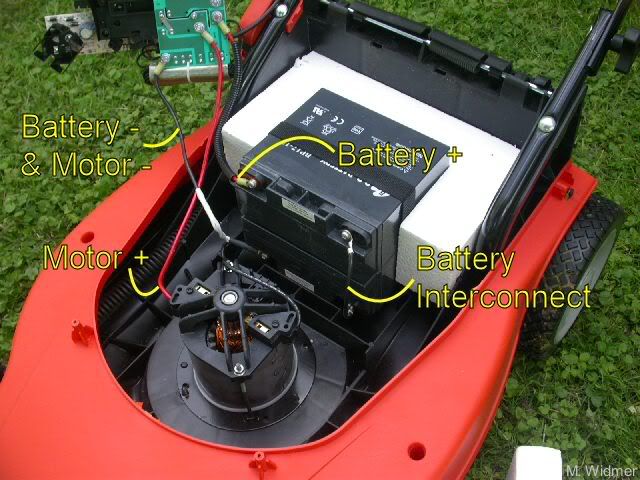 Note the wiring of the two 12V batteries in series, to generate 24V for the motor.
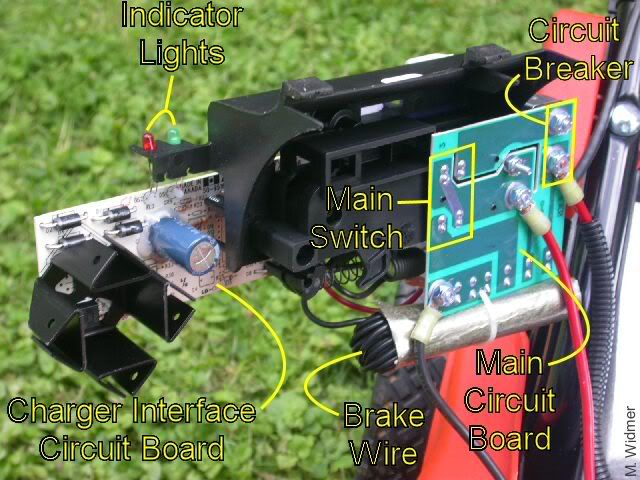
There are two printed circuit boards inside the mower. Black and Decker says nothing about them in the owner's manual, so I have taken it upon myself to name them:
1. The Main Circuit Board (green side visible in photo below) sends power from the battery to the motor. It contains the main switch and circuit breaker.
2. The Charger Interface Circuit Board (white side visible in photo) controls the recharging of the batteries, and is (apparently) not active when the mower is in use.
Click on photo for full picture.
Here is the circuit schematic for the CMM1000, Type 5. I imagine Types 1 through 5 may all have the same circuit, and perhaps the CMM1200 does as well, but I wouldn't swear by it.
Click on figure for full picture.
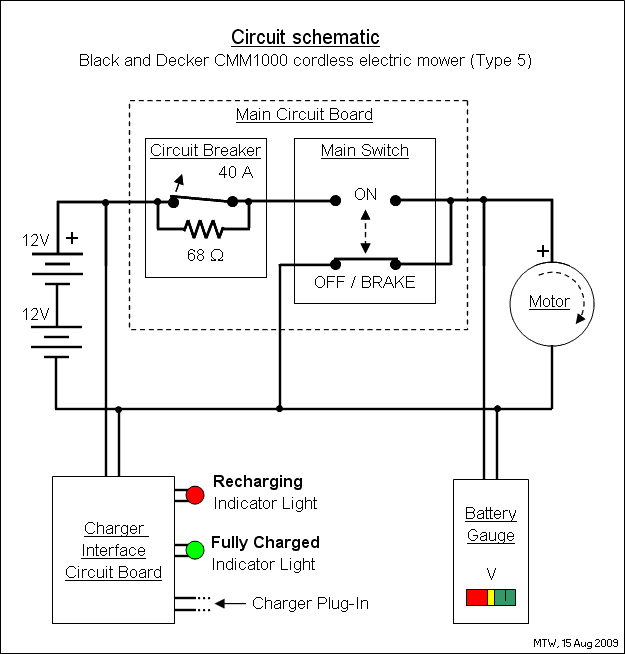
Some rambling observations about the circuit:
1. The two 12V batteries are wired in series to produce 24V. The batteries that come with the mower are from B.B.Battery, model # BP17-12 (17 Amp-hours, 12 Volts). I have since replaced them with 22 Amp-hour batteries of the same physical size. I'll write more about them in a future blog.
2. The Main Circuit Board controls the power to the motor via a circuit breaker and the main switch. The main switch is controlled by a cable that runs up to the handle where you, the user, pull on it using the switch lever.
3. If the mower is running and the operator releases the handle, the main switch returns to the "Off/Brake" position. This disconnects the battery and instead shorts the motor terminals. Without going into details, the short provides a fast breaking action for the motor rather than letting it spin down gradually. When the breaker opens and the handle is not released, the main switch stays in the "On" position and the motor spins down gradually.
4. The brake wire used to short the motor is rather long, and makes 14 loops of a roughly 5" x 1" area. (See 3rd photo.) Perhaps this is to provide some small inductance, but I don't understand exactly why this would be beneficial.
5. The circuit breaker is rated for 24V and 40A. It contains what appears to be a bimetal switch. Presumably the heat generated when the current rating is exceeded bends the bimetal into an open position. I have found that about 30 seconds after opening, the breaker switch on my mower has cooled enough to close and the mower may be restarted. I also found that heating directly with a hair dryer does not cause the bimetal to open, so it must be quite hot when it does.
6. There is a 68 ohm resistor inside the circuit breaker. It would provide a current path whenever the breaker opens, and is here presumably because of the inductive load presented by the motor. I'm admittedly curious about why the resistor is there and details of what it really does. (How I got in the position of prying open the circuit breaker is a story for another day.)
7. The Charger Interface Board is a maze of components and it would take a long time to break it down into a detailed schematic, so for now it remains something of a black box. The main features (not shown here) are 4 diodes + 1 capacitor (full wave rectifier?), an LM317 regulator, and a 14-pin IC. There are also oodles of resistors and some more diodes and capacitors. All I know for certain is, as shown in the schematic, that it contains the two indicator lights and receives the charger plug.


This comment has been removed by a blog administrator.
ReplyDeleteHi Mark this is super helpful. I'm a big fan of these mowers since they are quiet and efficient... as a matter of fact I have two of them (one of them is for spare parts). I'd like to ditch the white styrofoam and replace the batteries with some serious 12 volt riding lawnmower batteries made by SuperStart. I can get them at Schucks for $25 each and they have 275 cold cranking amps. They'd fit perfectly and if I wire them in series the way the originals were, then i'd get the 24 volts. My goal here is to be able to mow a lot more grass before having to recharge... however I'm wondering if the charger would work properly with the bigger batteries or if I need to retrofit somehow? Seems like sometimes right now the charger is too smart for its own good and the light turns green and it stops charging the batteries before they're full. I'm hoping my new batteries will work and the existing charger can be used. I wonder would it be possible to just hook the charger output wires direct to the batteries... or does that circuit board actually tell the charger when to stop charging the batteries so they don't overcharge? I'm guessing that's built into the charger... any thoughts? Lastly, and i know this will sound a bit eco-crazy... but if I have two small marine solar panels wired in series to produce a 26v output and 2 amps, could i ditch the stock charger altogether and use solar? If so, how would i keep the batteries from overcharging (since i'm guessing this feature is built into the charger)?
ReplyDelete-Mike
Hi Mike,
ReplyDeleteI would expect the built-in charger to work on larger batteries, and just take longer to charge them. (I wouldn't want to use it on smaller batteries without knowing more about the charging current, since you want to be sure you don't charge the batteries too fast.) As long as the Amp-hour rating of the batteries is at least 17, you're probably okay.
I'm not familiar enough with solar chargers, or making DIY battery chargers, to advise you on those. Sorry!
Regards,
Mark
Thanks Mark, any thoughts on my battery charger problem? Have you heard of other situations where the light turns green and the charger stops charging BEFORE the batteries are actually charged? Right now it goes for a few minutes and at first the charger appears to work properly by putting bursts of 26 to 29 volts in into the battery. The battery voltage then starts to climb steadily from 13.5 to up around 15 volts but then the charging light goes from red to green and the charger stops doing anything even though the batteries are still very weak. I'd like to upgrade the batteries if that's what is needed, but don't want to do that if the charger or something else is the problem. Have you run into this before or do you have any ideas? Perhaps it would be safe to hook the charger up directly to the batteries to see if the circuit and charging indication light are what's causing the trouble.
ReplyDeleteThanks,
Mike
This comment has been removed by the author.
DeleteI haven't heard of behavior like that before, but it sounds like your batteries are near dead if they are only at 13.5V. Two questions for you: (1) how old are the batteries, and (2) do you stop mowing when the batteries first show signs of being drained (for CMM1000, battery meter needle in upper red zone) or keep mowing? Also, could you check each battery's voltage individually?
ReplyDeleteI've read that batteries should last 4 years or more if properly cared for, but it could be less if they get drained too much during use, or aren't kept charged during the winter.
I don't know why the charger gives a green light at just 15V. There might be something in the circuit that senses the batteries are near end of life, but I'm just guessing on that.
p.s. feel free to contact me: mark (at) harbormist (dot) com, the communication might go faster that way. (I thought there was a link here somewhere to send me email, but I can't find it.)
Thanks Mark, the batteries are maybe four years old... and we drain them pretty much all the way down and then (try to) charge them all the way up. I'd heard that was the right way to keep from getting "memory"... but sounds like I may have been misguided. I think we might have also left them dead for the winter. Sounds like I've done everything wrong?! I'll disconnect them and check independantly... I suspect you're thinking that if one is much lower voltage than the other then I'll have found the problem? Sounds like a plan. Then after that I'll see if I can hook the charging wires up to the batteris directly to charge them up. Thanks!
ReplyDeleteHi Mike,
ReplyDeleteI would not hook up the charger plug-in unit directly to the batteries. Use the circuit in the mower, it has a voltage regulator and circuitry to prevent overcharging.
Sounds like it is time for new batteries! I would replace BOTH batteries, regardless of what you find when measuring them separately. Four years is not a bad life for them, from what I have read in reviews at Amazon.com.
Different battery chemistries have different recommendations for draining vs. not draining. For these batteries (lead acid, just like your car battery) it is best *not* to drain them fully. The CMM1000 mower has a gauge showing the batteries' condition, and the manual says to stop mowing when the indicator needle reaches the lower "red" zone of the meter -- even though the mower is still capable of cutting grass. I find, when I'm at this point, that recharging for just 1 hour is enough to finish up my 1/4 acre.
The CMM1200 mower does not have a battery gauge, so if that's what you have you are on your own to judge when the battery charge is low. I think if there is a noticeable drop in power then it is time to stop. For some reason the CMM1200 manual does not discuss this issue, though the CMM1000 manual does.
Hi Mark, thanks for the prior insights. I went ahead and bought the two monster batteries and put them in there. The mower performed incredibly with them-- far better than new and perhaps well beyond what B&D had ever dreamed of... although my neighbors probably think I'm crazy now, because I turned on the backyard floodlights and mowed my 6" deep lawn in the rain at dusk. The mower did a great job and was barely discharged afterwards! On a dry summer day, I suspect I could mow over an acre on a single charge! It boggles my mind why they didn't put the big batteries in there as original equipment... they'd have killed the gas mower long ago with that kind of performance. I mean, sure the mower is another 10 or 15 lbs heavier, but the extra weight isn't even noticeable (although my yard is flat)! So anyway, that was the good news. The bad news, is that I now seem to have the opposite problem with my charger. When I hooked it up, it begain charging normally, with the charging light showing red and this time it continued charging... even after the battery was fully charged. I stayed around with my digital test meter hooked up, and finally had to disconnect the charger when the batteries hit 25.5 volts... I think it would have just kept going! Any ideas what to do next? I was thinking, if I put a couple leads directly to the battery posts, and then drill a hole in the side of the housing and have them dangle out, then I could charge the batteries directly (bi-passing the circuit board) using a store-bought general purpose 24 volt battery charger (which I would presume would have some overcharge protection built into it). Thoughts on that approach or any alternate ideas?
ReplyDeleteThanks,
Mike
Hi Mike,
ReplyDeleteFully charged batteries could be as high as 27 to 29 volts, so I'm not convinced (yet) that the charger is at fault. Also, higher capacity batteries will take longer to charge than you may be used to. Do you know the Amp-hour (Ah) rating of your new batteries? With that information, we can probably guestimate how much longer charging should take -- the batteries that come with the mower are rated for 17 or 18 Amp-hours.
Also, how long did it take to reach 25.5 volts? You may be being overly cautious, which is a good thing of course.
Mark
Hi Mark, I charged it up today for about eight hours and the voltage got up to 29.2 before I finally disconnected it. The red light stayed on and the charger was still going to town, so i got worried it was going to mess up the batteries. Here is the battery info:
ReplyDeleteSuperStart Part No U1LJ
Cold Cranking Amps: 160
Cranking Amps: 200
Reserve Capacity: 30
There are two of them, so I guess that would make the reserve capacity double then, to become RC 60? I'm not sure if that's the same as amp-hours. Can you tell from that, how long I can leave the charger on before I risk overcharging?
Thanks,
Mike
Hi Mike,
ReplyDeleteI wasn't familiar with the "Reserve Capacity" rating before, but after googling I found ***this:
"Reserve Capacity (RC) is a very important rating. This is the number of minutes a fully charged battery at 80 °F will discharge 25 amps until the battery drops below 10.5 volts."
(Note, this is for a 12V battery)
So your batteries (RC=30) would last 30 minutes at 25 amps. We don't double the number for series-connected batteries. Also, this means the Amp-hour rating is
(25 Amps) x (1/2 hour) = 12.5 Amp-hrs
(I used 1/2 hour because that's what 30 minutes is.)
This is weird, that's less than the 17 or 18 A-h rating of the original battery. Maybe your new batteries are designed for high current, at the expense of a shorter run time. The CMM1000 motor runs at 12 Amps, so a 200 Amp battery is overkill here. Since you have bought the batteries, you might as well go ahead and try them and see how they do.
Not sure what to do about your charger. You could buy a separate charger if you want to try that, but you should probably ask either the battery seller or charger seller what charging current they would recommend for your battery. In the future I'd charge to 27V to be on the safe side if using the mower charger.
DIY battery charging is getting outside my area of expertise though, so playing it safe is the best advice I can offer at this point.
Mark
***source: http://www.batterystuff.com/tutorial_battery.html
I've been working on a CMM1000 that shuts down randomly. Circuit breaker trips. FYI - I monitored the on board battery charger and it charged to 27.6vdc and displayed green light. I disconnected the charger and reconnected it and the batteries charged to 29.7vdc before the green light came on. Not uncommon, like in a car, the charging system will produce 14-14.5 volts. Hope this helps.
ReplyDeleteBTW, anyone else have circuit breaker trip issues? Appears a bad breaker since I'm not drawing any where close to 40A. Any help is mush appreciated.
Ted,
ReplyDeleteThis was happening to mine last year (mower was 3 years old). Replacing the breaker fixed the problem:
http://markselectricmower.blogspot.com/2009/11/fixing-problem-june-2009.html
You can order a new breaker here:
http://www.ereplacementparts.com/circuit-breaker-p-100616.html
Regards,
Mark
Howdy Mark,
ReplyDeleteIn the top of this posting you mention that you used 22 Amp-Hour batteries and you'd provide details in a future post. I can't find that. Can you point me to that or provide the info on where you got those? Thanks very much.
Hi Mike,
ReplyDeleteSorry, I have been meaning to blog about that with the full info.
I bought two of part # TR22-12 from batteryspec.com :
http://www.batteryspec.com/cgi-bin/cart.cgi?action=link&product=68
-- Mark
Continuing that last comment ...
ReplyDeleteThe batteries were $42 each, and shipping was $30 for a total of $114.
Hi Mark,
ReplyDeleteI got new batteries because the charger would run indefinitely, but the red charging light would not go out. I replaced the batteries and left the charger running overnight, but it still indicated that they were not charged. When I put the key in and turn the switch, it just clicks (the first time the mower made a slight noise, but also did not start).
I checked the voltage with my multimeter across the two battery terminals on the left and it reads 27v. Both the batteries I took out read over 12v.
Any ideas about what could be broken?
Any batteries with a cold cranking amp rating are not really suited for deep discharge cycles. The lifetime of the battery is likely the suffer in the wrong application.
ReplyDeleteAll... I appreciate you all putting all the details of the BD mowers in here. But there is one spec I am looking for...
ReplyDeleteDoes anyone know what type of motor is in here? Is it a brushless motor?
Has anyone every used these motors for wind mill projects? If so, how many RPM volts were you seeing?
Thanks,
++Todd
The motor has brushes. Not sure about the RPM-volts relation, maybe somebody else can chime in.
ReplyDelete-- Mark
Hi Mark,
ReplyDeleteMy CM1000 died suddenly a few weeks back. It was the battery. Information your presented was very helpful. After reading your blog I was able to order the TR22-12 battery with absolute confidence (still $42 + $30 S&H) instead of paying B&D $135 + tax for a somewhat inferior battery. Didn’t buy the TD22-12 since it was a bit more expensive and I figured if I don’t let the battery discharge excessively (recharge before the gauge gets to yellow) I should get enough life out of TR. Received the batteries earlier this week and things are looking great :)
I believe I will need the brushes next. Brushes for this model seem to have been discontinued. Fortunately I was able to find some at http://www.abtecparts.com/commerce/search/products/?product_id=10XBD24227300&merchant_id=1933. Haven’t received them yet so don’t know if they will actually work, but at $15 it seemed like good insurance to have.
Any way, just wanted to stop by and say thanks.
-Ajay
You're welcome Ajay, and thanks for posting the link to abtecparts.com. Always good to have an alternate supplier.
ReplyDeleteThe abtecparts link to all Black & Decker mower parts is:
http://www.abtecparts.com/black_&_decker_lawn_mowers.htm
And for other mower brands:
http://www.abtecparts.com/lawn_mower_parts.htm
Regards,
Mark
Great Blog and Just FYI
ReplyDeleteMy CMM 1000 was recalled then rebuilt as a CMM 1200 at the end of last season, New charger, new switch, handle. I just replaced the battery(s) 12V 17 Amp. It took a very long time to charge the new batteries 22+ hours. I just turned it on and the motor runs stronger than it ever has. The only concern is the red light on the charger stays red. WIth my old battery the indicator turned green but the run time under a 1/2 hour. Any clue why the red indicator stays on and is there a concern?
From looking at previous comments exchanged here (with MikeM, March 12 2010), I would guess -- and it's just a guess -- that these aren't quite the correct batteries for the mower. "Chris", (see June 2010, above) reported the same problem but I was at a loss as to how to help :-(
ReplyDeleteIs your battery rating for 17 Amps, or is it 17 Amp-HOURS (17 Ah)? Is there any other tech info for the batteries?
Final comment (for now): you might try asking at www.lawnmowerforum.com . It's an online lawnmower forum I just joined a couple of weeks ago. Most of the people there use gas mowers, but there is a small number of electric mower folks as well. More people seeing your question = better chance of correctly troubleshooting the problem.
Hi Mark,
ReplyDeleteIn regards to an earlier post, Mike asked about using a solar set up to charge the mower. I used this solar/battery setup ( http://www.sustainlane.com/reviews/how-to-build-a-solar-generator/KFY2FIT8BTVDN888J7FDQKKKK8YO ) with some changes (stuff I already had or equivalents I found cheaper) for camping and then set it up for charging my mower when not camping. I just plugged the mower's stock AC charger into the inverter and didn't worry about trying to make a direct charge circuit from the panels to the mower.
Jeff
Hey Mark, thanks for the blog, used it to determine my problem was the circuit breaker, got a new one, and like an idiot, didn't pay close enough attention to which wires went to which post. Are there schematics anywhere?
ReplyDeleteHi,
ReplyDeleteRefer to the 3rd photo on this page, and the Main Circuit Board in that photo.
Along the bottom of the Main Circuit Board are the six connection posts, they are located on the side facing away from you in the photo (as you are probably aware). If you look on the other side of the board, these posts are labeled. Going from left to right in the photo here -- or right-to-left, if you turn the board around so that you can actually see the posts -- the post labels and wire connections are as follows:
"Black" - black wire from what I call the Charger Interface Board in the photo
"Brake R" - wire from coiled-up wire brake (either wire may connect here)
"Fuel Gauge Blk" - black wire from fuel gauge (actually a voltmeter)
"Brake R" - other wire from coiled-up wire brake
"Fuel Gauge Red" - red wire from fuel gauge
"Red" - red wire from Charger Interface Board
Just as a sanity check on the order, "Black" and "Fuel Gauge Blk" (and one of the "Brake R"'s) are located toward the end where the heavy black wire connects to the board in the corner. (NOT the red wire with the black coiled sheath, I mean the wire with only black insulation and no red.)
Briefly, the Charger Interface Board connections allow the battery to charge, the brake is a safety feature that stops the motor quickly when the mower is shut off (otherwise it just slows down gradually when shut off), and the fuel gauge reads the voltage across the motor.
Hope that helps! Post back if anything is not clear.
Mark
Hmmm, mine doesn't have the "board", just the little circuit breaker with one brass prong and one silver one. There's a white wire coming from the handle, a red one coming from the battery, and another red one attached to the motor. Those are the only wires I have. I assumed the brass post should be attached to the battery, while the other two went on the silver post, as I recall there being two wires attached to that one. I may, however, be having a total senior moment.
ReplyDeleteIt sounds like you have a CMM1200, not the CMM1000. Or maybe you got the upgrade-to-CMM1200 they started doing after the 1000 was discontinued.
ReplyDeleteI have some photos of the inside of a friend's CMM1200 that I just took another look at. They show the red wire from the battery going to the copper post on the breaker. The silver breaker post gets the white wire from the handle AND the red wire from the motor.
Mark
Yes, sorry, thought I'd said which model I had.
ReplyDeleteSo I do have them installed correctly. Thank you so much. Unfortunately, mower still isn't starting.
Just to establish whether the breaker is working or not -- for test purposes only -- you could connect the two red + white wire together on the same breaker post. If the mower starts, the breaker is faulty. If it doesn't start, the problem is something other than the breaker.
ReplyDeleteDo you have a voltmeter/ohmmeter? That would be useful to check for faulty wiring. Another possibility is that the motor brushes are worn out and not making contact with the motor.
Thanks, I'll try that. So glad you're here.
DeleteHi Mark,
ReplyDeleteI found your thread after some extensive searching. I'll start by saying I'm admittedly very new to working with electronic devices. I've got the CMM1200 model that I've been trying to get working since my key box started recently smoking. I took apart the key box and found that one of the contact points was burnt out. An electrically inclined neighbor gave me a jumper device so I can plug and un-plug a connector to complete the circuit. I soldered this to both of the contact points and plugged the connector in. Unfortunately no power was going to the motor. My next thought was that it's probably the circuit breaker. I used your suggestion above as a means of testing this theory. I plugged all 3 (red, red, white) wires to the same post on the breaker (tried both posts just in case), and still not getting any power when I pull the switch.
I'm sure that the batteries are charged, and I'm confident the motor works. I'm afraid something else could have been damaged from the ole smoking key situation. I have a multimeter for testing (although I don't know a lot about how to properly configure it) and tried setting it to the 20k Ohm setting. When I touch both points of the circuit breaker the reading shows 0, which to my understanding means there is no resistance. Again, I'm not sure if that's important or relevant.
Any ideas or suggestions for next steps would be greatly appreciated.
Chris
cracked the code earlier tonight. There was some confusion on my part about the jumber that the neighbor gave me. I needed to solder 2 points together on the plug side to complete the circuit. Thanks a bunch for all the valuable information on your site. I've got a much better understanding of my mower now.
ReplyDeleteHi Mark,
ReplyDeleteA quick update on my Tempest TR22-12 batteries. It’s been just a little over a year and 16 charge cycles (kept a log) so far and the batteries are dead! Things had been going great until two weeks back when I could barely finish 1/4th of my yard and the fuel gauge hit yellow. I recharged and the same thing happened again. Thinking that the charger was not up to par for the new 22AH batteries as they aged, I ordered the 24v 5amp BC-24-5000F Tempest charger. Hooked it in over the weekend. Charger turned green after about three hours. I tried to mow my lawn today and the motor could barely start. When I opened the mower I found that the batteries had swelled up and deformed. Not sure if the old B&D charger had done something bad to the batteries and the high charging current from the new charger then killed the batteries or the batteries died on their own. The B&D charger never actually turned green until I pulled the AC adapter out and put it back in. I am back to square one. Not sure if I should order the TD22-12 this time since I already spent $60 on the charger or I should consider a different alternative.
Good to see that folks are still being helped by your blog ;)
Regards,
-Ajay
Hi Ajay, welcome back.
ReplyDelete(Others can scroll up to April 2011, to see Ajay's earlier post.)
I have sworn off the 22 A-hr batteries for this mower. I had posted in July 2011 -- a few months after you posted -- that mine lasted only 2 years. Your experience just adds to my limited evidence that they don't last as long as the 4-5 years that is expected out of the 17-18 A-hr battery that was provided with the mower. I would stick with the lower capacity 17-18 A-hr battery from now on.
FYI:
http://markselectricmower.blogspot.com/2011/07/another-new-battery.html
-- Mark
ChrisL: sorry for not replying sooner to your July 8 post. Glad things worked out for you. -- Mark
ReplyDeleteMark,
ReplyDeleteJust found this blog and am glad. I have a CMM100 Type 5. It sat idle for a couple years and the battery bit the dust, or so I thought. I could not get it to charge in the red cycle, plugged in and went straight to green and never took a charge. Bought new batteries hoping that would fix it. No such luck. Still no red cycle charging. Then I had a friend give me an older CMM1000. It too had sat idle for an unknown time frame. It charges red cycle, but no green...I swaped teh boards from the new old one to my original with the new batteries and still only get the red cycle charge. I don't think there are any replacement parts available for this thing. Any thoughts?
mower will not run charger shows battery's are charged. key on pull lever and nothing happens. some time back replaced breaker and pin on run lever. this is a great mower but i need it. this mower is 6 years old still using original battery could this be the problem?
ReplyDeletemy mower is cmm1200
ReplyDelete6 years is a long time for these batteries to hold up, so it is very possible that you need a new one. That being said, I am surprised that nothing at all happens, I would expect the mower to still run but for a shorter and shorter time between chargings, so there might be something else going on too.
ReplyDeleteI suggest posting mower problems at the LawnMowerForum, www.lawnmowerforum.com You'll have to create an account, but it is free and there are more people who will see your question there and hopefully offer their input.
There is a Black and Decker part of the forum at:
http://www.lawnmowerforum.com/black-decker-forum/
This comment has been removed by a blog administrator.
ReplyDeleteMy CMM1200 has an orange colored charger with a connector that plugs into the switch on the handle. It has 3 terminals marked "comm", "-", and "+"
ReplyDeleteIf I want to remove the battery and use the charger to charger it over the winter, do you know which 2 connections would work?
I have had problems starting my cmm1200.
ReplyDeleteI think it is the safety shutoff( Deadman handle) I take the cover off check the wires and replace cover-- sometimes this corrects the problem but not this time!
Hi. My dad used my mower last week and cut my grass. Now I went to use it today and nothing. It wont start at all. I checked the box where the handle is connected and nothing is wrong there. Any ideas? Maybe its the breaker or god forbid the batteries? How would I go about testing the breaker without going out and purchasing one? Its CMM1200. If ya got any ideas shoot me an email at anneblue82@hotmail.com.
ReplyDeleteThanks for your time.
Quick question: Can anyone tell me, what are the voltages corresponding to the green/yellow transition and to the yellow/red transition on the CMM1000 "fuel gauge" (volt meter)?
ReplyDeleteWhy I'm asking: My CMM1000 died completely after a few years, and it clearly wasn't just a dead battery problem. I took out the circuit board, and sure enough, there was a cracked resistor in the charge circuit, and it was scorched badly enough that I couldn't read the color bands to order a replacement. I found this blog, thinking that I could look up the resistor value from the circuit diagram, but found something even better: News of a recall! I put the mower back together and sent it in, and it came back upgraded to a CMM1200 (yay!), but it no longer has the gauge (meter). I bought a 30V meter on eBay for a few bucks and plan to wire it across the motor, but I would like to paint the yellow and red zones on it so that my wife doesn't run it all the way down and shorten the battery life. Would somebody be willing to (a) measure the voltages at the transitions, or (b) tell me where I can get my hands on one of the old CMM1000 gauges, at least to borrow it temporarily?
Important note:
ReplyDeleteIf you have a question to ask, please ask it at Lawn Mower Forum, either in the Black & Decker area or the Electric & Battery Operated area at that website. I apologize for being unable to handle individual requests for help posted on this blog or sent by email.
Link to Lawn Mower Forum's main page: http://www.lawnmowerforum.com/forum.php
From there you'll find the Black & Decker section (under "Brand Specific Forums" and the Electric & Battery Operated section.
Best regards,
Mark